Guide
Guide
Buying municipal Christmas decorations: the RFP, the spec and the order date
A city buys holiday decorations on a public calendar, and imported decorations run on a factory's. This guide covers when to start, what to put in the specification and the price schedule so bids compare, and wording you can adapt.
Routes
Three ways a city buys holiday decorations

Which route you are on decides what you write, who places the order with a factory, and who owns the decorations in January.
Buy them outright
The city writes a specification, issues an RFP or a bid, and owns what it buys. The winning bidder supplies the goods and sometimes installs them.
Buy through a cooperative programme
Some public agencies buy through cooperative purchasing programmes, where another agency has already run the solicitation. Suppliers say which programmes they are on.
Hire a decor contractor
The contractor designs, installs, removes and often stores the decorations, and usually owns them. The factory order is then the contractor's, on the same calendar.
Timing
When to start: the calendar for imported decorations
The calendar works back from the install date through production, the ocean and rail legs, the customs entry and a buffer. It uses custom displays, the longest chain we quote.
Holiday lighting tenders go out from late winter into summer. This year we saw cities post them in March, May and July. For imported custom pieces, the award has to come before the factory can book production, and we plan on 8 to 12 weeks to produce custom steel and lighting work. After that the container crosses the ocean, often with a rail leg inland, and clears customs before the install crew starts.
If you buy through a procurement process, put its length in front of the order date. A tender that closes in late spring and awards in June can still make a November install, but only if the drawings are approved quickly after the award.
For your own dates, work the order date back from the install month on the buying calendar.
Specification
Write the specification: performance, not pictures
Describe what each piece has to do and where it goes. Bidders can price a requirement; they cannot price a mood board.

A schedule of assets and locations
Each piece on its own line: what it is, how many, and where it goes. A photo of each location helps bidders more than a paragraph about the theme.
Size and viewing sides
Height and width, and whether each piece is seen from one side, from both sides of a street, or from all round.
How each piece mounts
For pole mounts, give bidders blanks to fill rather than leaving them to guess: pole height and diameter, the bracket or banner arm already on the pole, and whether there is power at the pole. For ground pieces, say what they stand on.
Colour and animation
Warm or cool white, any colours, steady or animated. If pieces must match decorations the city already owns, send photos of those.
Power and control
Ask each bidder to state the power and control each structure needs, so the city can check it against what each site has.
Weather
If a location is exposed, state the conditions the pieces must stand up to and ask bidders how their design meets them.
Packing and spares
Frames that knock down, crates with the assembly drawing inside, and a list of spare parts to hold for later seasons.
Price schedule
A price schedule that makes bids comparable
Give bidders a schedule with one line per cost. Two bids can then be read side by side instead of total against total.
| Line | What it covers | Why it gets its own line |
|---|---|---|
| Design and drawings | Dimensioned drawings for the city to approve before production | Some bidders fold design into the goods and some charge for it; a separate line shows which. |
| Goods | Each piece on the asset schedule, priced per unit | It is the line most bids agree on, and a single total can hide everything else behind it. |
| Freight and delivery | Factory to the city's yard or site, by container and truck | Imported decorations carry ocean freight that a bare unit price leaves out. |
| Customs entry and duty | The broker's entry, the tariff line and the duty | Duty on imported lighting and steel moves with tariff policy. A named line makes a change visible. |
| Installation and removal | Crew, lifts and permits, each season | Often a different contractor. Pricing it apart lets the city award it apart. |
| Storage | Where the decorations live from January to October | It is a cost every year, and some tenders require storage off site. |
| Maintenance and spares | Repairs in season and a stock of spare parts | Failures happen in December, when replacements are hardest to get. |
On the duty line, ask each bidder for the tariff line they priced against, the rate, and who carries a change between the award and the day the container lands. Our quotes state all three. To compare bids on landed cost, put each bid's lines into the calculator.
Imported goods
Origin, duty and the tariff line in the bid
Ask every bidder where each item is made. A bidder reselling imported goods and one building locally can both answer honestly, and the answer changes the lead time, the duty and what happens if a piece fails in December.
Duty is charged at the rate in force on the day of entry, not the day of the bid. On a tender awarded in June and landed in October, that gap is months long. Say in the solicitation who carries a change in duty over that gap, so every bidder prices the same risk.
If a domestic-preference rule applies to your contract, the solicitation has to say so. Whether one applies is a question for your procurement office or counsel. A bidder who cannot meet it should say so in the bid, not after the award.
Our own answers are on How we work: which company invoices you, and who carries a tariff change. Shipping and duties explains what the freight, entry and duty lines of a landed quote cover.
Evaluation
Scoring the bids
A grid the city can adapt. The emphasis column is an example; the city sets its own weights.
| Criterion | What to look for | Example emphasis |
|---|---|---|
| Price | The total from the price schedule, with every line filled in | High |
| Delivery against the install date | A dated plan from award to install, with production and transit shown | High |
| Match to the specification | Drawings that meet the asset schedule and the mounting blanks | High |
| Service in season | Who answers a failure in December, and how | Medium |
| Qualifications | Drawings of similar work, insurance and references, in the form the city's rules require | Medium |
References, insurance and bonding are the city's requirements to set. Ask for them in the solicitation rather than assuming every bidder holds them.
Later seasons
After the award: storage, upkeep and the next season
Commercial decorations are bought to last several seasons, so settle before the first install who stores them, where, and with what inventory. A tender that requires off-site storage should say so, because it changes who can bid.
Keep the approved drawings. Reorders and replacement pieces are quoted from the drawing on file, so a piece added in the third year matches the ones bought in the first. Spare bulbs are worth holding as well: C9 bulbs and socket wire for trees and rooflines are ordered by the pallet or the container.
Used commercial decorations also come up for sale. Before buying, check the frames for rust and cracked welds, test the lighting, and ask for the drawings, since spare parts and matching pieces are made from them.
Sample wording
Clause wording you can adapt
Sample wording, not legal advice. Your procurement office or counsel fits it to your rules.
Scope
"The contractor shall supply the decorations listed in Schedule A, built to the approved drawings and delivered to the locations in Schedule B by [date]."
Origin
"For each item, the bidder shall state the country in which it is manufactured."
Tariff line and duty
"For each imported item, the bidder shall state the tariff classification and the duty rate used in its price, and whether the bidder or the city carries any change in duty before delivery."
Drawing approval
"Production shall not start until the city has approved dimensioned drawings showing the front, back and base of each structure, with its mounting and power."
Test before shipment
"Each lit structure shall be tested before packing, and photographs of the test shall be supplied to the city before shipment."
Packing
"Each structure shall ship knocked down where its design allows, with its assembly drawing packed inside its crate."
Where we fit
What we can supply into a solicitation
We are a trading company. We have decorations made in China and deliver them landed, to a city or to the contractor it hires.
Goods to the city's specification
Pole-mount motifs and street displays built to drawing, giant wreaths and garland for building fronts, and C9 bulbs and socket wire for trees and rooflines.
Dimensioned drawings
Drawings for the city to approve before production, showing the front, back, base, mounting and power.
A landed quote
Goods, freight, the entry and the duty line itemised, with the tariff line, the rate and who carries a change.
The invoice a public agency needs
If you are a public agency and need to pay a US vendor, say so in your request and we will quote from our US company.
What we do not do
We do not install, maintain or store decorations on site, and we are not on a cooperative purchasing programme. A contractor who installs can buy from us.
Where this applies
The products this guide covers
Each product page has the price drivers, the order-by calendar and the quote form for that product.
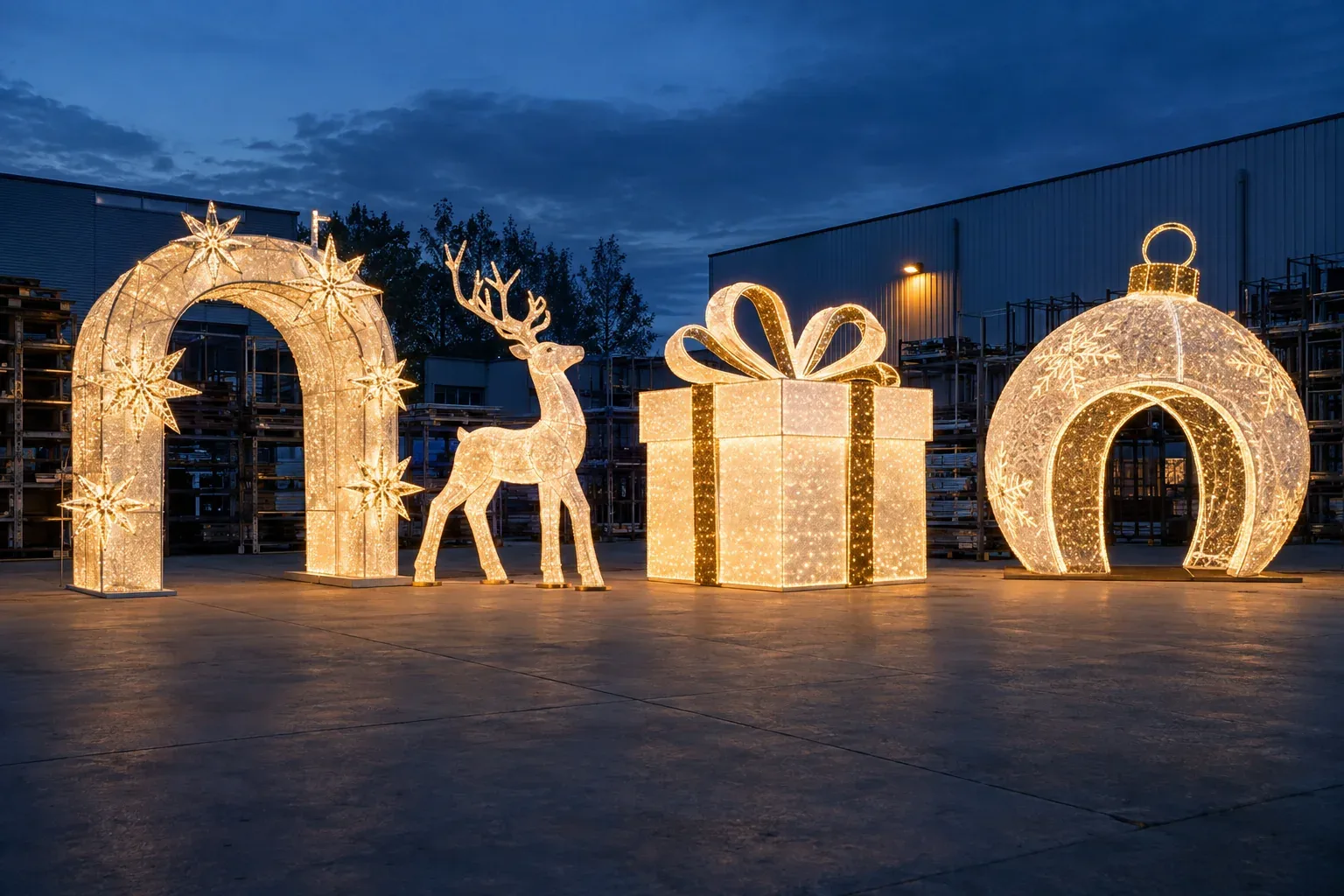
Custom LED motif displays
Walk-through arches, animated figures, tunnels and photo-op structures for light attractions, downtowns and parks. We build from your drawing or make one from your sketch, crate the structures to fit the container, and clear them through customs at the other end.
See the displays
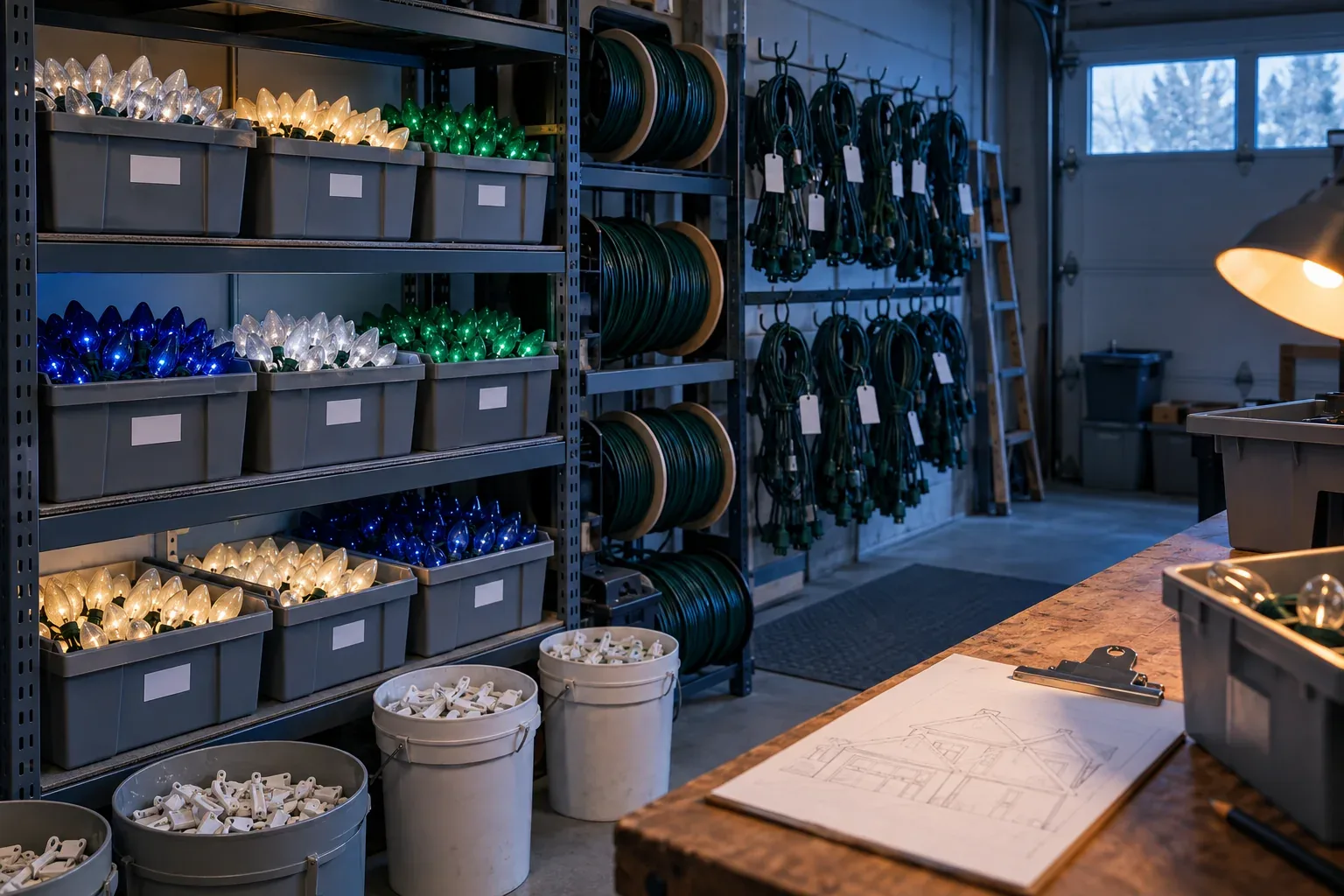
C9 LED Christmas bulbs
Replacement and new-install C9 LED bulbs for professional displays. We have shipped them to the same customers season after season, usually with the socket wire and plugs that go with them.
See the C9 bulbs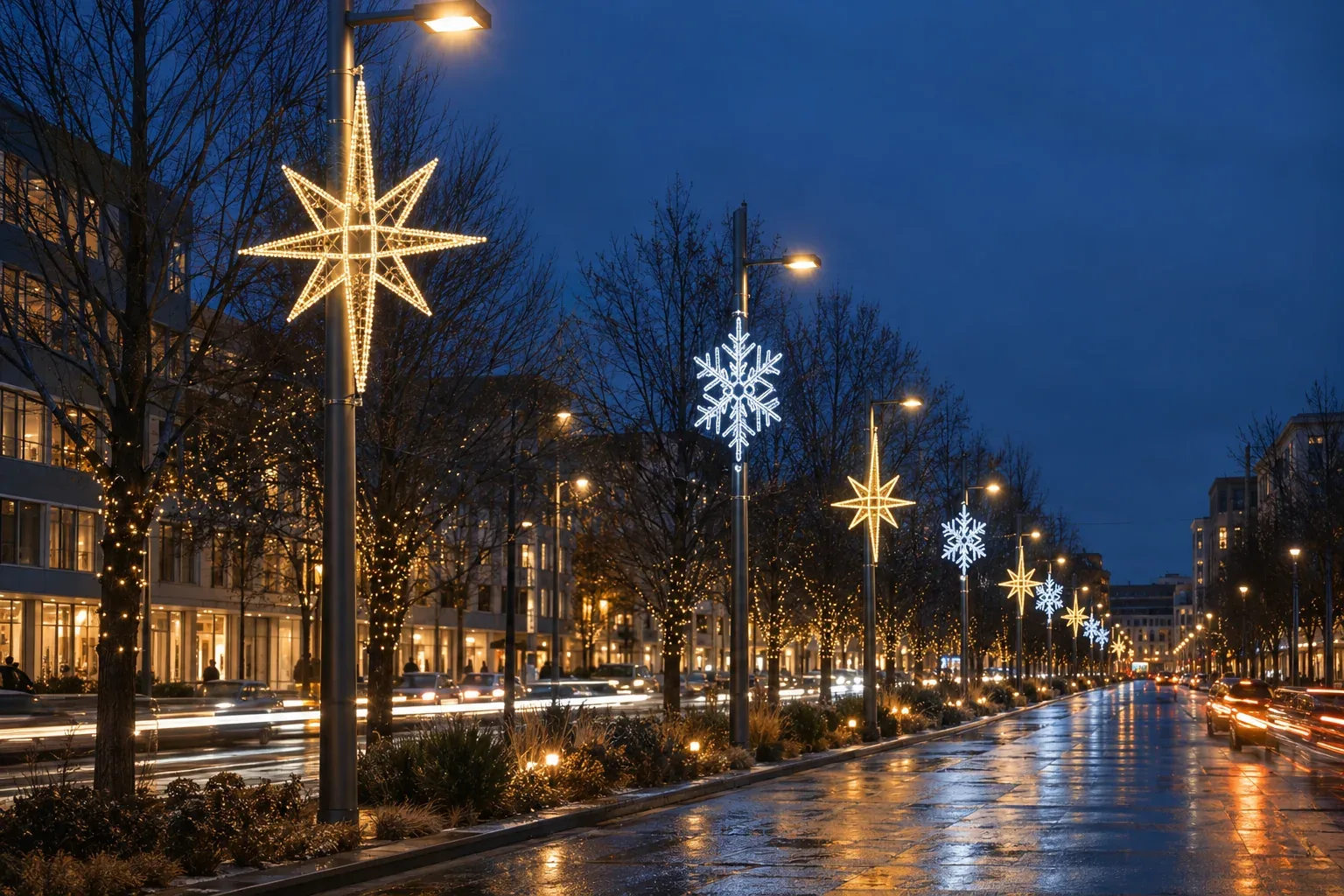
Pole-mount Christmas decorations
Lit snowflakes, stars, bells or your own city's motif, made to fit the poles on your streets. Tell us about the poles and who owns them, send a design or a sketch, and we build the frames, crate them flat and quote them landed.
See the pole decorationsWhere to go next
- The buying calendarThe order date worked back from any install month.
- How we workWhich company invoices you, and who carries a tariff change.
- Landed cost calculatorPut two bids side by side on landed cost.
More guides
More guides: Commercial Christmas lights and displays
 Guide
Starting a Christmas light installation business: what to buy, where and when
The kit an installer buys, when to order it, whether to buy from US stock or by the container from China, and what commercial clients ask for.
Read the guide Guide
Mall Christmas decorations: the plan, the approvals and the order date
What a shopping center has made to fit its spaces, who approves each piece before it goes up, and when to order so it lands before install.
Read the guide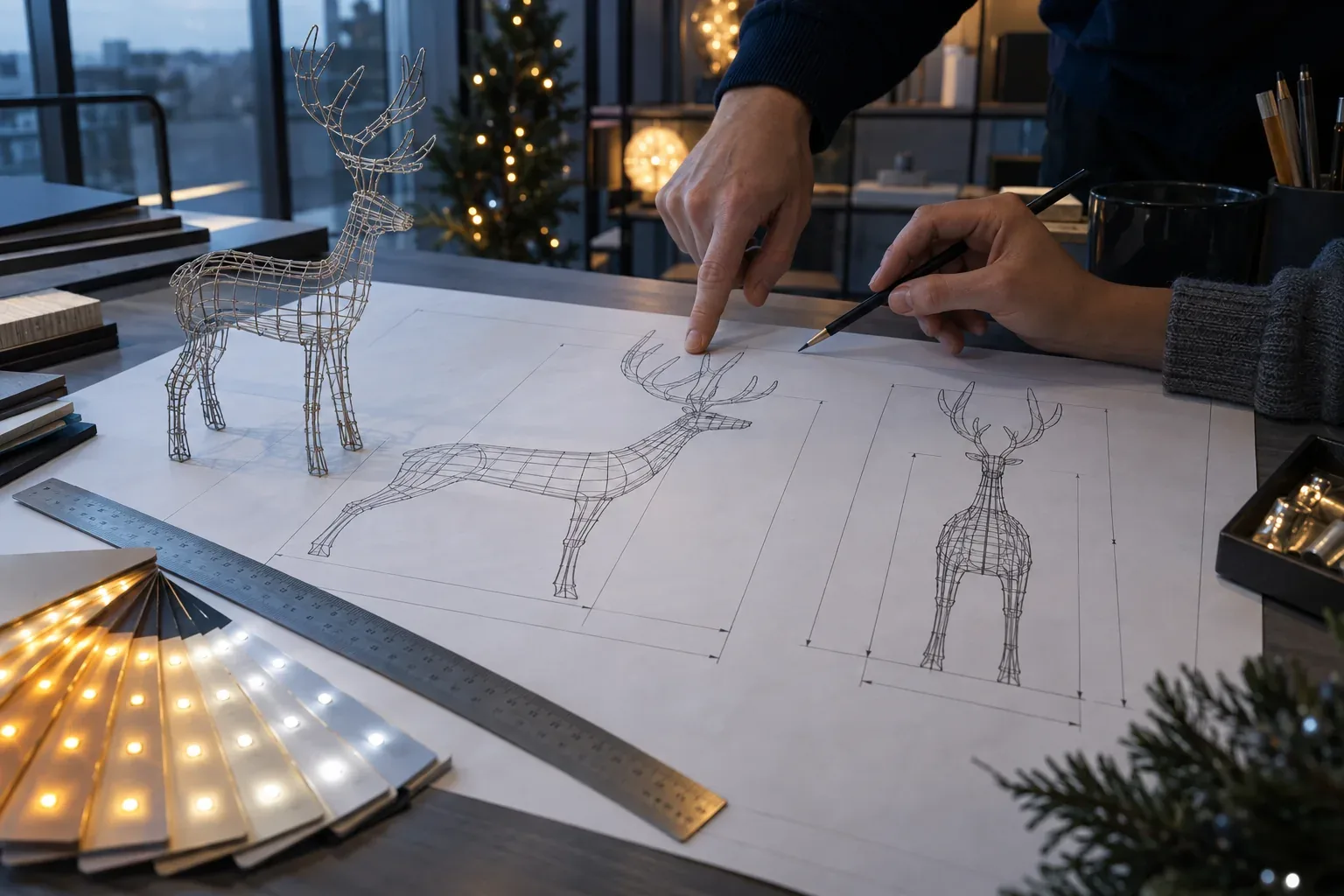 Guide
How a custom Christmas light display is made, from sketch to container
The steps from a sketch to a crated, lit steel display, and what the factory needs from you at each one.
Read the guide
Questions
Questions buyers ask
Where can a city buy used commercial Christmas decorations?
Used commercial decorations do come up for sale. Before buying, check the frames for rust and cracked welds, test the lighting, and ask for the drawings, because spare parts and matching pieces are made from them.
How do you decorate a light pole for Christmas?
With a pole-mount motif: a lit frame fixed to the pole with a bracket or the banner arm already on it. To buy them in quantity, measure the pole height and diameter, note the bracket and whether there is power at the pole, and put those in the specification. The pole-mount decorations page covers the mount and the motif.
What are lit Christmas decorations for streets called?
In the trade they are motifs: lit steel frames, flat or 3D. On streets they are usually pole-mount motifs on lamp posts, garland or overhead pieces across the road, and larger figures in squares and parks.
Does a city need an RFP to buy holiday decorations?
It depends on the city's purchasing rules and the size of the purchase. Smaller purchases can often be made on quotes, and some agencies buy through cooperative purchasing programmes that have already run a solicitation. Your procurement office sets the thresholds.
How far ahead should a city order imported holiday decorations?
Work back from the install date: production (we plan on 8 to 12 weeks for custom steel and lighting work), the ocean and rail legs, the entry, and a buffer before install. For a November install that puts the award in early summer and the RFP in spring. The buying calendar does the arithmetic for any date.
Who owns and stores the decorations under a decorating contract?
Under a turnkey decor contract the contractor usually owns the decorations, installs and removes them, and stores them between seasons. If the city buys outright, it owns them and has to plan the storage. Say which you want in the solicitation.
Request a quote
A landed quote for your city's decorations
Send the asset schedule or a sketch, the quantities and the install date. We reply within 1 business day, and the quote itemises the goods, the freight, the entry and the duty line.
- Reply within 1 business day
- Landed cost, itemised
We take on the orders we can do well, and we will say so if yours isn't one of them.